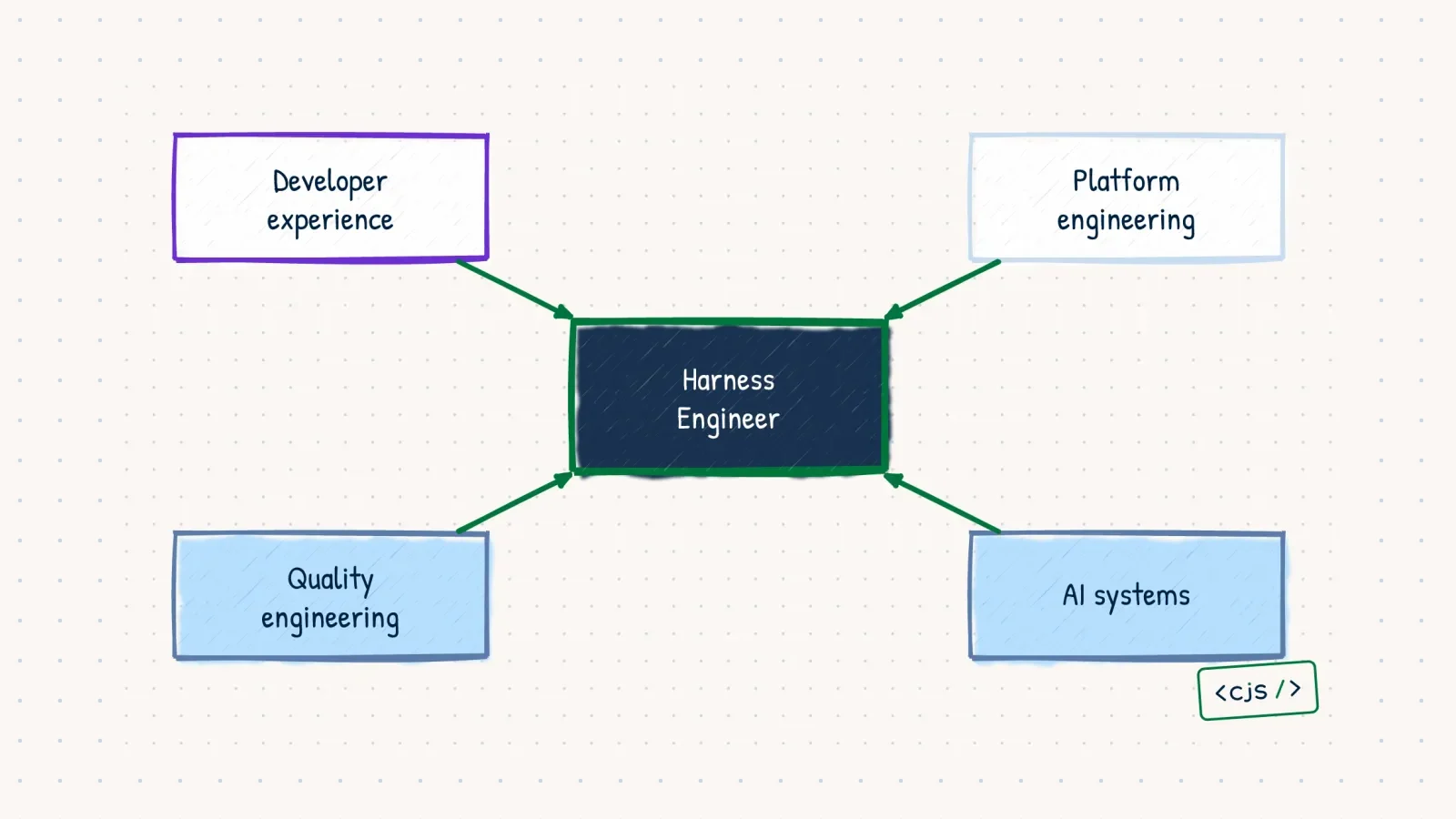
A Harness Engineer does not make a model smarter. They make useful work easier for an agent to understand, execute, verify, and hand back safely.
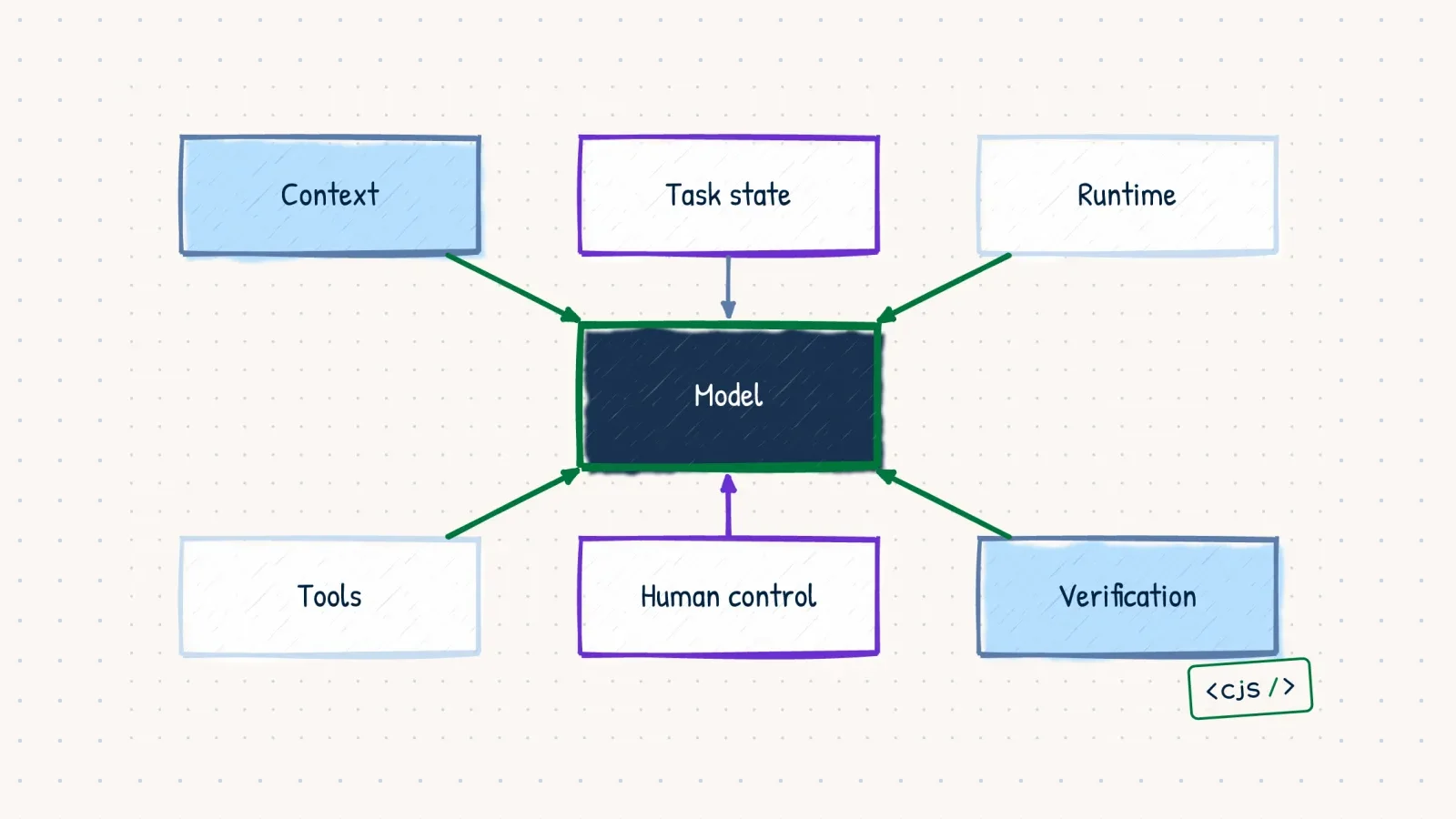
That means owning the environment around the model: context, tools, runtime, policy, observations, and evidence. The role is emerging because agent reliability is increasingly a systems problem, not a prompting trick.
A responsibility, not necessarily a job title
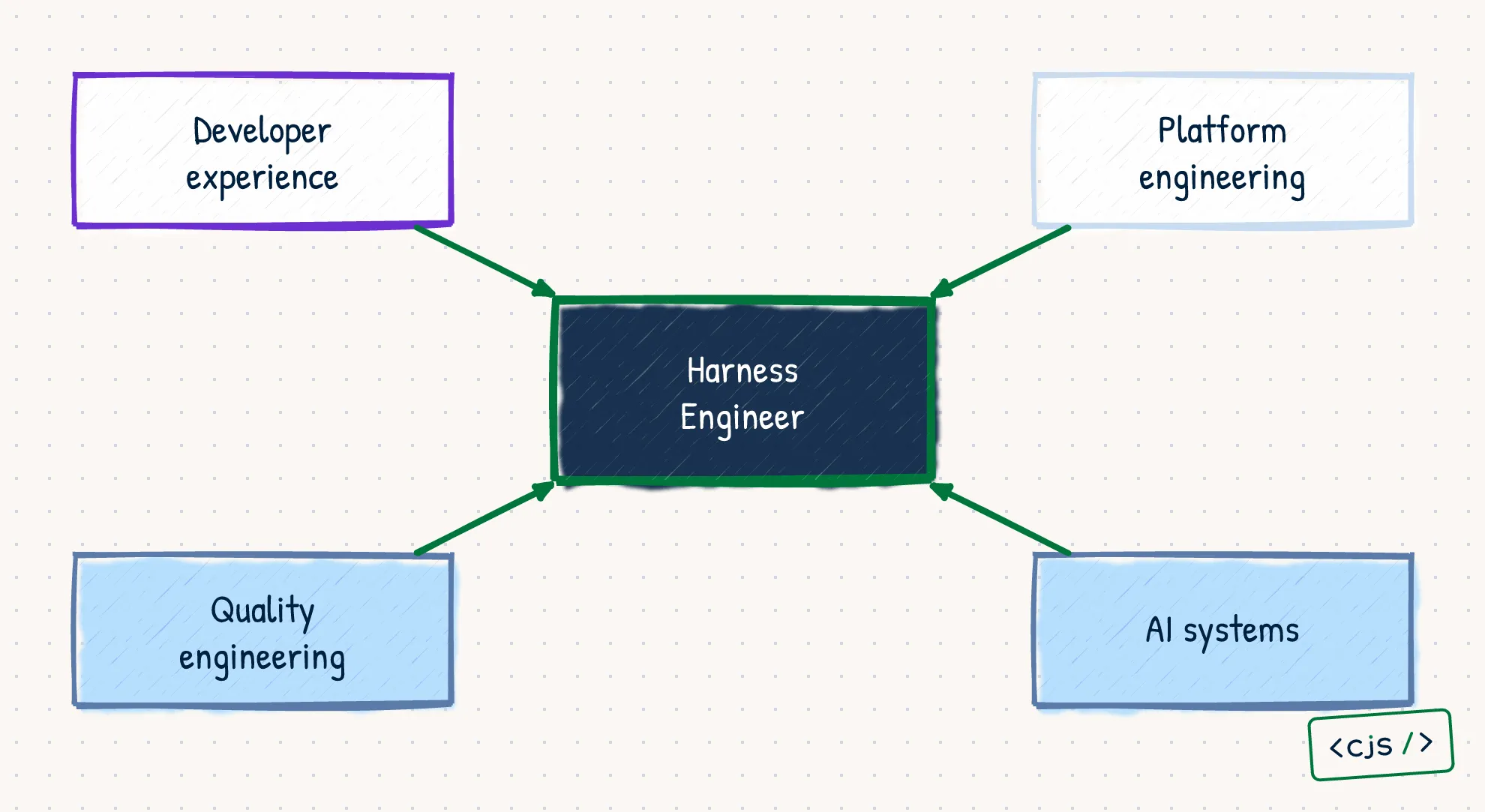
Harness Engineer may be a formal title or a responsibility shared across platform, developer-experience, quality, security, and AI product teams.
The boundary matters more than the label. Product engineers own the outcome, platform engineers own stable infrastructure, security defines risk policy, and quality engineers shape test strategy. The Harness Engineer connects those concerns inside the agent’s working environment.
OpenAI’s harness engineering account describes the human shift as designing environments, specifying intent, and building feedback loops while agents execute. This is not “stop engineering and supervise prompts.” It is engineering at the interfaces where intent becomes action.
Avoid centralizing every agent decision in one platform team or leaving every developer to rediscover the same failures. Centralize primitives and standards; federate domain knowledge and task-specific evals.
The six skills form one system
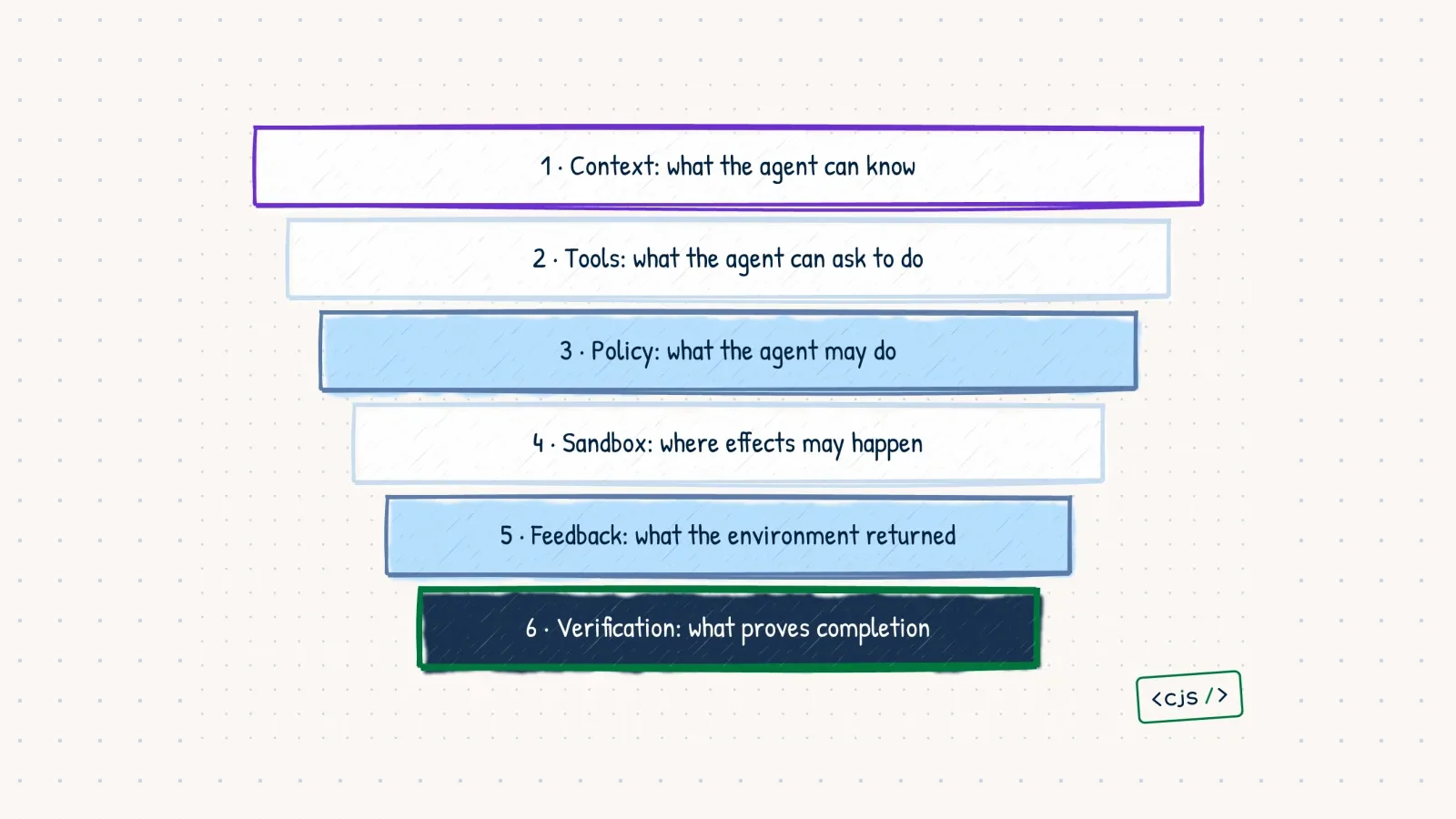
The six-layer harness model is also a practical skill map. A Harness Engineer needs depth somewhere, but creates leverage by understanding how the layers interact.
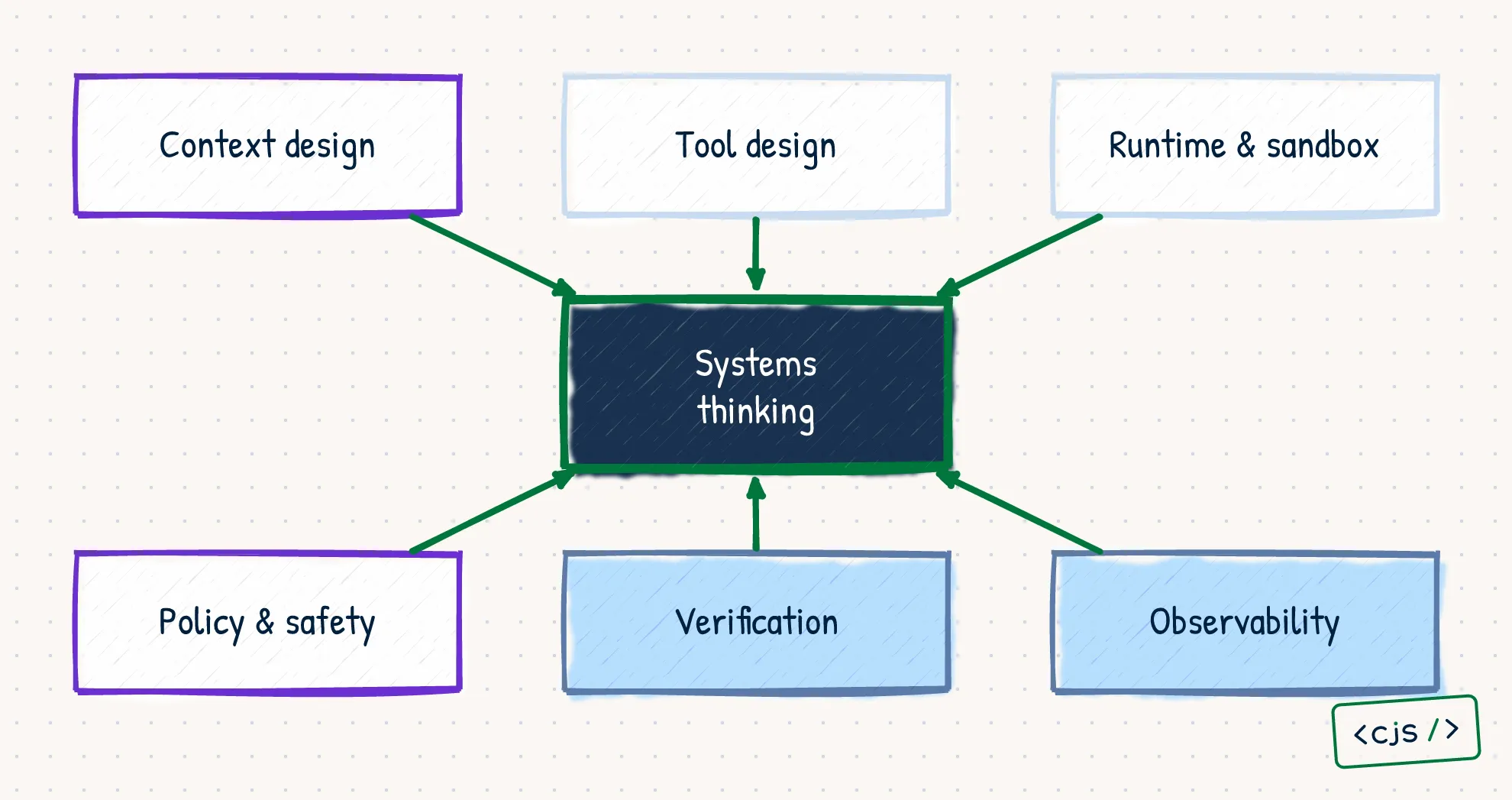
Context design makes project knowledge discoverable through repository maps, scoped instructions, examples, task state, and structured handoffs. The goal is the smallest context that changes the next decision.
Tool design turns capability into reliable action with narrow contracts, explicit inputs, bounded outputs, useful errors, and safe defaults.
Runtime and sandbox engineering makes execution reproducible. Worktrees, containers, fixtures, seeded data, permissions, and timeouts bound the agent’s effect on unrelated state.
Policy and safety translate organizational constraints into enforceable gates. Approval boundaries, secret handling, network access, destructive-action rules, and least privilege should be visible before the risky call, not reconstructed after an incident.
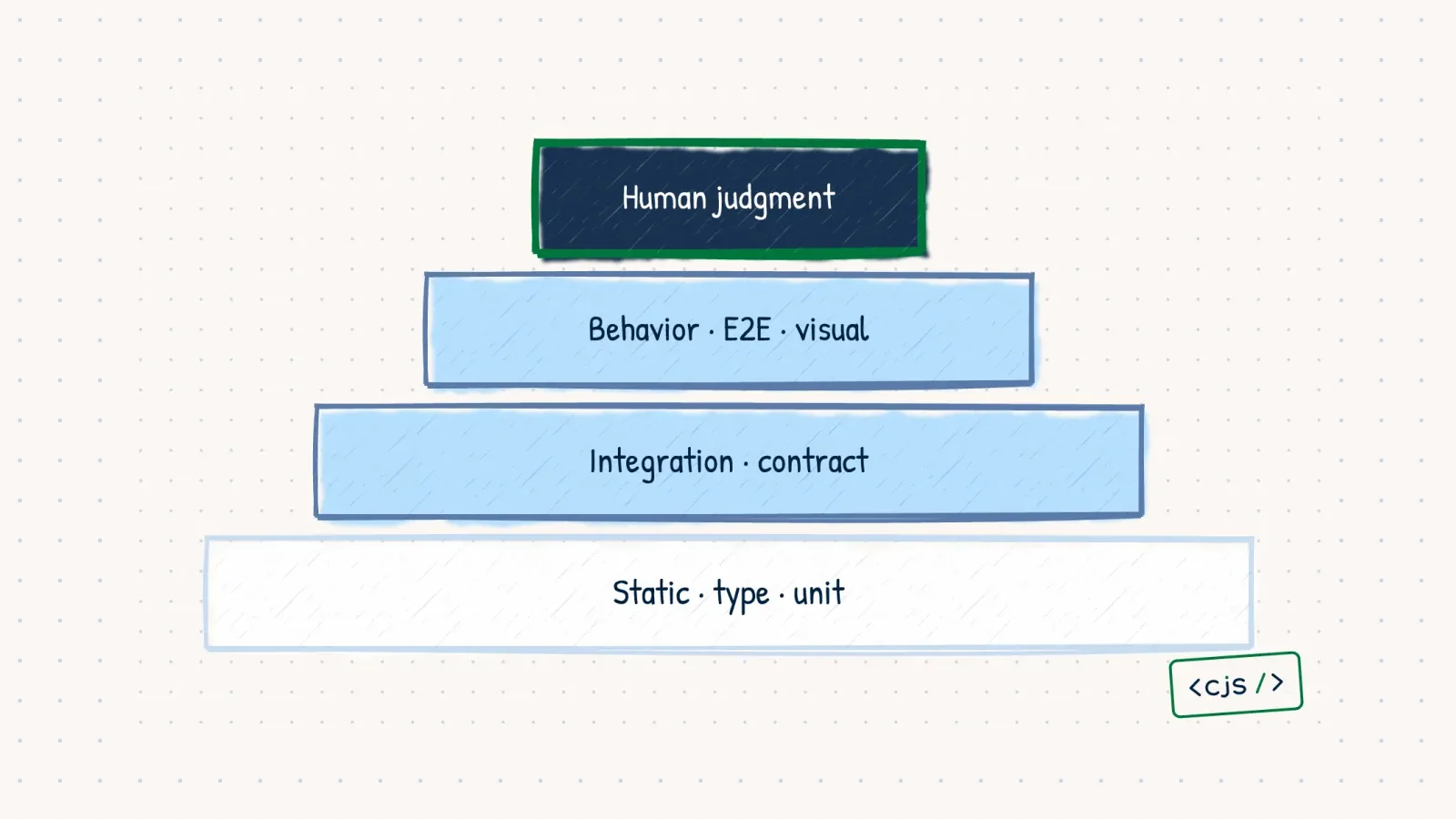
Verification defines observable completion. It combines static checks, focused tests, integration and behavior checks, visual review, rubrics, and human judgment. As the previous article argued, the completion claim must remain smaller than the evidence.
Observability turns failures into diagnoses. Traces, tool results, state transitions, cost, latency, and retry reasons reveal where the harness—not only the model—needs work.
These are engineering skills: API design, test architecture, infrastructure, security, data analysis, and technical writing. Prompt craft helps, but it cannot compensate for an illegible repository or an untestable outcome.
Diagnose maturity by the feedback loop
Teams often measure adoption by seats, prompts, or generated lines. Those numbers say little about reliability. A better maturity model asks how intent, action, evidence, and learning connect.
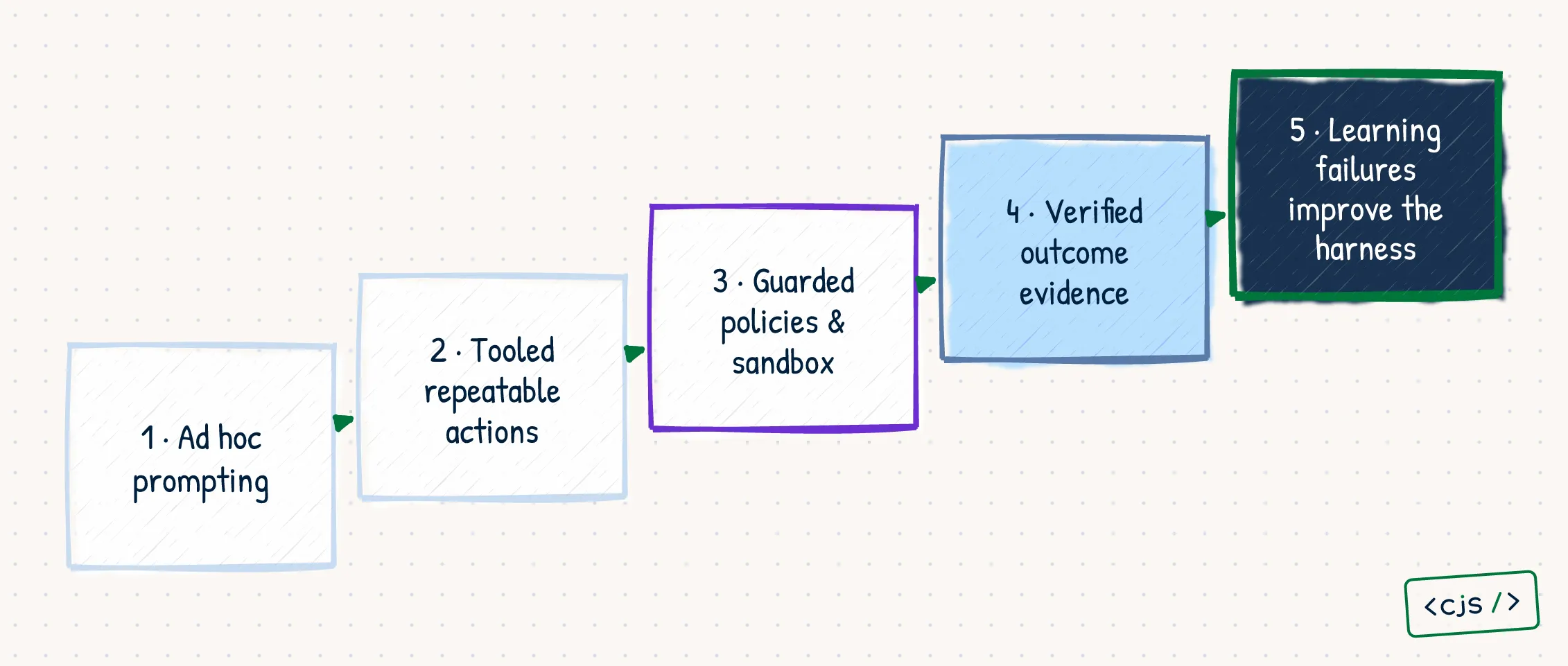
At ad hoc maturity, success depends on one person’s prompt and manual checking. The workflow may be useful, but it is hard to repeat.
A tooled workflow gives the agent stable actions and enough project context to complete a narrow task. A guarded workflow adds isolation, permissions, budgets, and human checkpoints proportional to risk.
A verified workflow defines acceptance before execution and returns reviewable evidence. It can distinguish “the command passed” from “the requested behavior exists.” Finally, a learning harness aggregates recurring failures and turns them into better instructions, tools, eval cases, and platform defaults.
The stages are not a race toward maximum autonomy. A production migration may remain deliberately guarded while a documentation fix becomes highly autonomous. Maturity is the ability to choose the right control level from risk and evidence.
Anthropic’s work on long-running agent harnesses emphasizes incremental progress and structured handoffs. Its later harness design research shows that harness components encode assumptions about model limits. Test and simplify those assumptions as capabilities change; complexity is not the asset.
A focused 90-day roadmap
Start with one workflow that is frequent, painful, and verifiable. “Make every engineer agent-first” is not a useful first project. “Reduce the time to diagnose and fix a failing frontend test” is concrete enough to baseline.
Days 1–30: map and baseline
Choose the workflow and name its owner, users, start state, desired outcome, and non-goals. Observe several real attempts. Record time to first useful action, time to verified completion, human interventions, repeated context requests, unsafe or blocked actions, and common failure classes.
Build a thin task bank from real work. Keep examples small enough to run often and diverse enough to reveal different failure surfaces. The baseline can be partly manual; its job is to make today’s system visible.
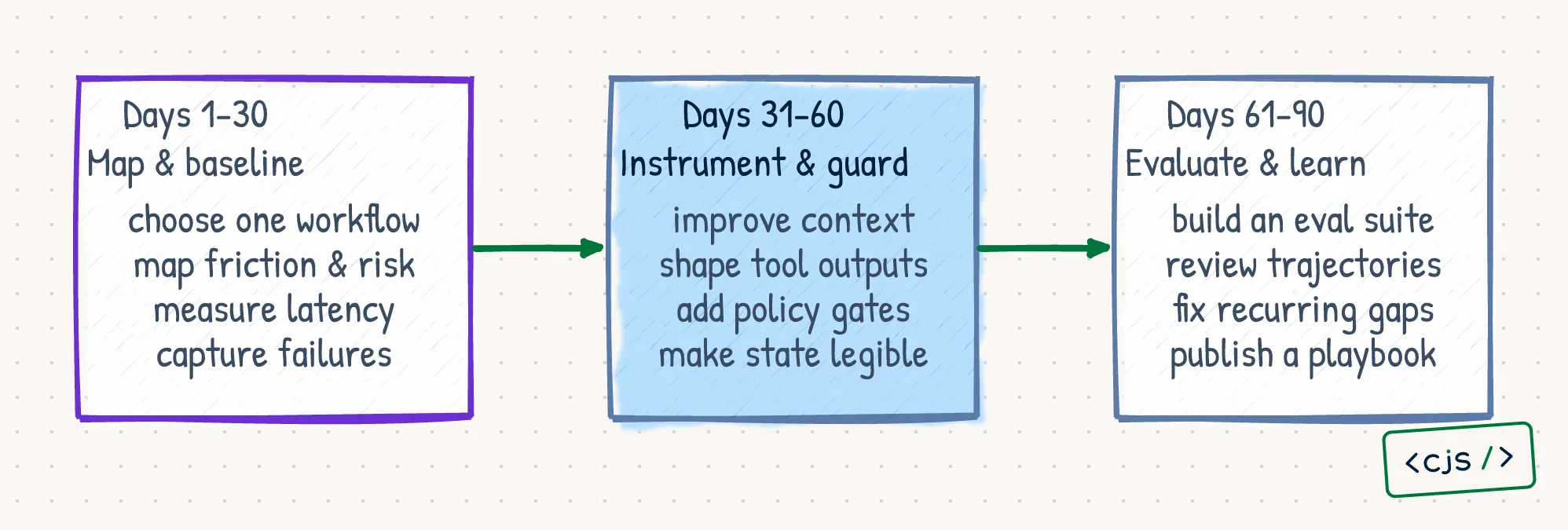
Days 31–60: instrument and guard
Improve the highest-friction interface. This may mean a repository map, a smaller tool response, a reproducible environment, a permissions gate, or a focused test command. Add structured traces and preserve decisive outputs.
Do not redesign every layer simultaneously. Ship one change, compare attempts, and keep it only when it reduces ambiguity or risk. Document the operating contract where both people and agents can find it.
Days 61–90: evaluate and learn
Turn the task bank into a repeatable eval suite. Grade outcomes and inspect trajectories for risky shortcuts. Review failures by layer: missing context, tool contract, runtime drift, policy mismatch, weak observation, or verification gap.
Publish a short playbook with the supported workflow, evidence required, escalation path, and known limits. Then decide whether to deepen the same workflow, extend the primitives to another domain, or remove harness machinery that no longer provides lift.
| Signal | Healthy direction |
|---|---|
| Verified completion rate | Up |
| Median time to evidence | Down |
| Human intervention rate | Down |
| Escaped defects | Down |
| Cost per accepted task | Down |
Pair metrics: speed without quality invites shortcuts, while quality without latency can hide an unusable process.
What good looks like
A good Harness Engineer makes the system legible to agents and humans. Tools fail narrowly, risky actions stop at visible boundaries, reviews begin with evidence, and failures become reusable test cases.
The role is successful when it gradually disappears into shared platform primitives, repository conventions, and team habits. It should not become a permanent translation layer between engineers and agents.
The model will change. The interface may move from CLI to IDE, desktop, CI, or an embedded service. OpenAI’s Codex harness architecture illustrates why separating the underlying loop from client surfaces matters. A durable Harness Engineer designs around intent, action, state, policy, and evidence—the boundaries that remain when the surface changes.
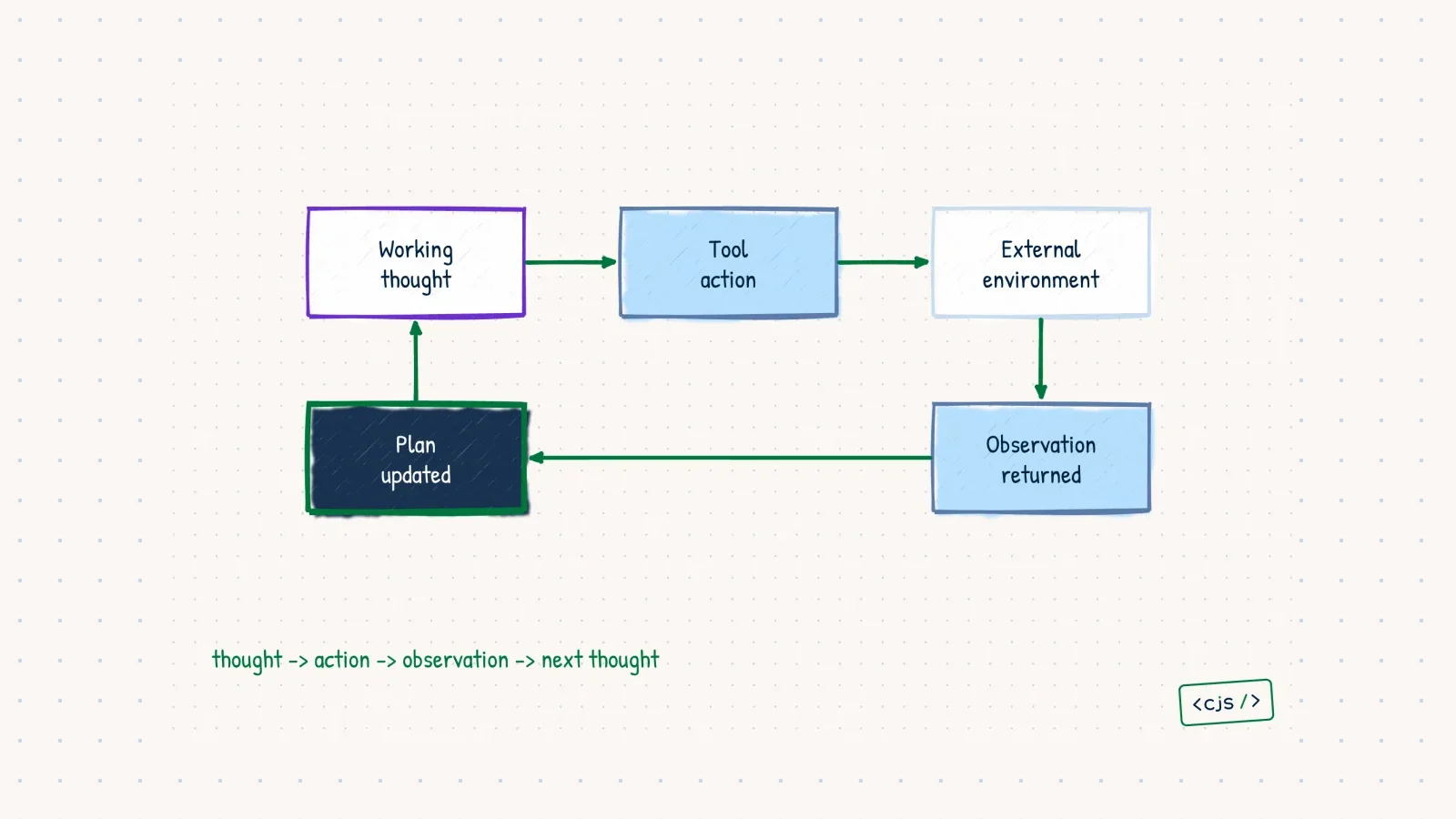
That closes the series. Test harnesses taught us to control an environment. CI made feedback continuous. AI pair programming expanded the task boundary. Tool use closed the action-observation loop. Coding agents made the whole system visible. Harness engineering turns that system into a discipline, and the Harness Engineer turns recurring failure into a better environment.
Sources
- OpenAI — Harness engineering: leveraging Codex in an agent-first world
- OpenAI — Unlocking the Codex harness
- Anthropic — Effective harnesses for long-running agents
- Anthropic — Harness design for long-running application development
- Anthropic — Demystifying evals for AI agents