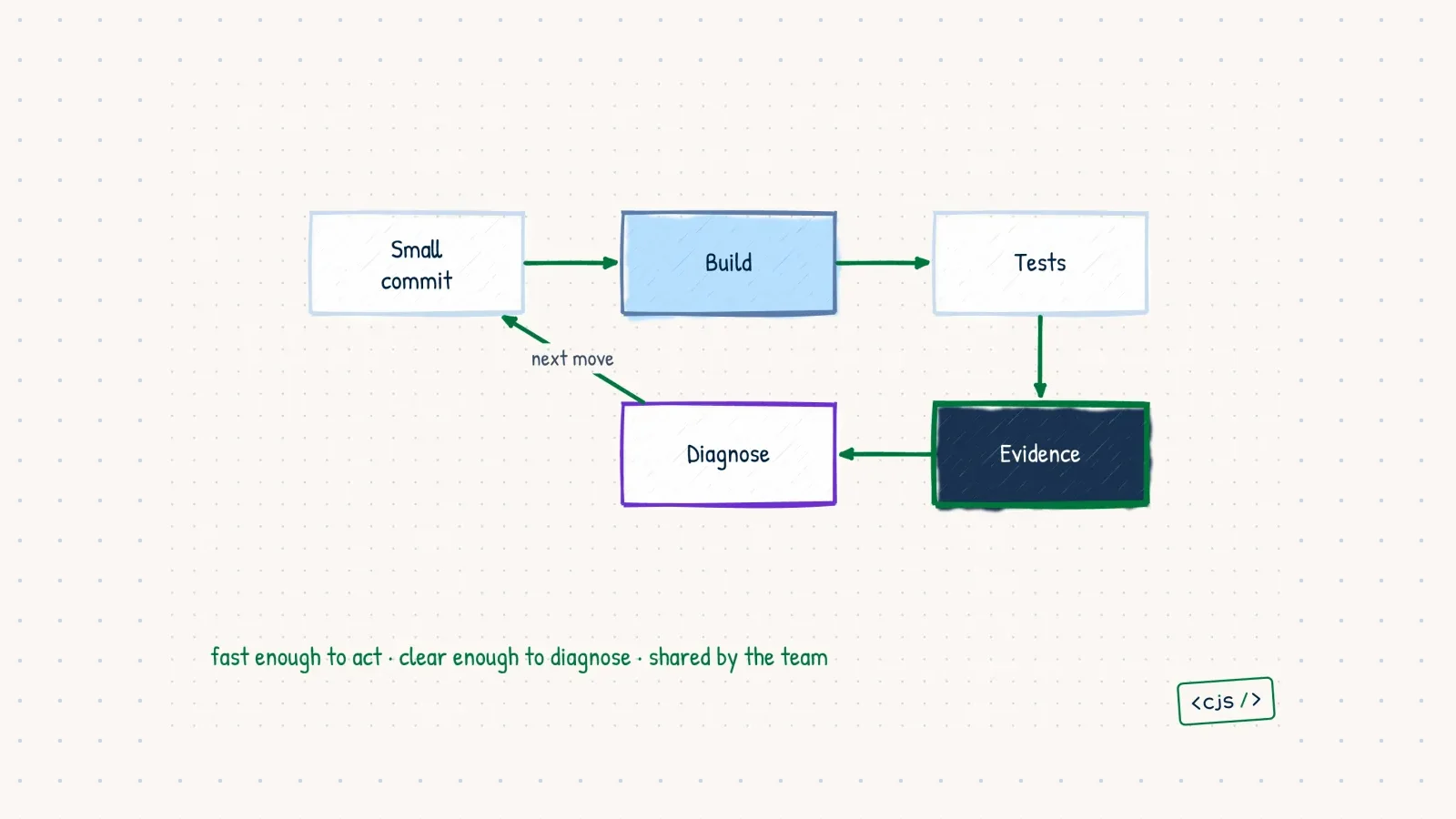
A test harness makes one run repeatable. Continuous integration makes that repeatability a shared team habit.
That distinction is the bridge from what test harnesses taught us before AI to modern agent workflows. CI did more than move tests onto a server. It created a common place where every small change could meet the same environment, checks, and response rules. The pipeline became infrastructure; feedback became its product.
Before CI, integration was a delayed event
Teams have always been able to run builds and tests. The problem was when those activities happened and whose machine defined the result.
When developers worked in isolation for days or weeks, integration accumulated into a batch. A failure after the merge could have many plausible causes: one change, the interaction between several changes, an environment difference, or a manual step that nobody recorded. The longer the delay, the wider the search space.
Martin Fowler and Matthew Foemmel’s original 2000 article on Continuous Integration described a fully automated, reproducible build—including testing—that could run many times a day. Fowler’s revised guide keeps the same core: team members integrate at least daily, and every integration is verified by an automated build with tests.
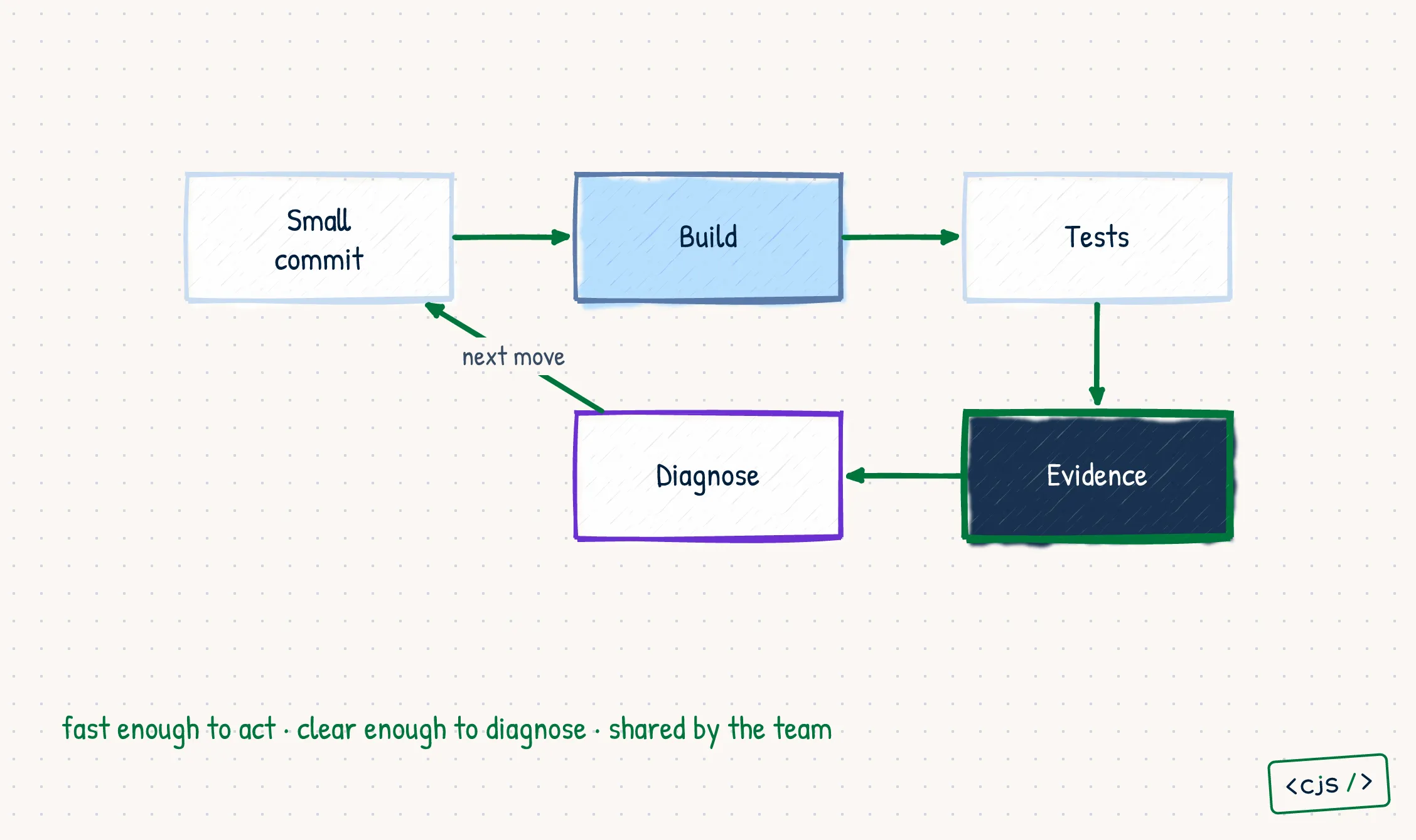
The important unit is not “a CI job.” It is a small change joined to rapid evidence. A server that builds one enormous merge at the end of the week automates a delayed event; it does not create a short learning loop.
Feedback latency is larger than test duration
Pipeline performance is often reduced to one number: how long the runner was busy. That is only the visible middle of the loop.
A developer waits before execution begins, waits while the build and tests run, interprets the result, finds the relevant failure, and then decides what to do. A five-minute test suite behind a twenty-minute queue is not a five-minute feedback loop. Neither is a fast red build whose only message is “something failed.”
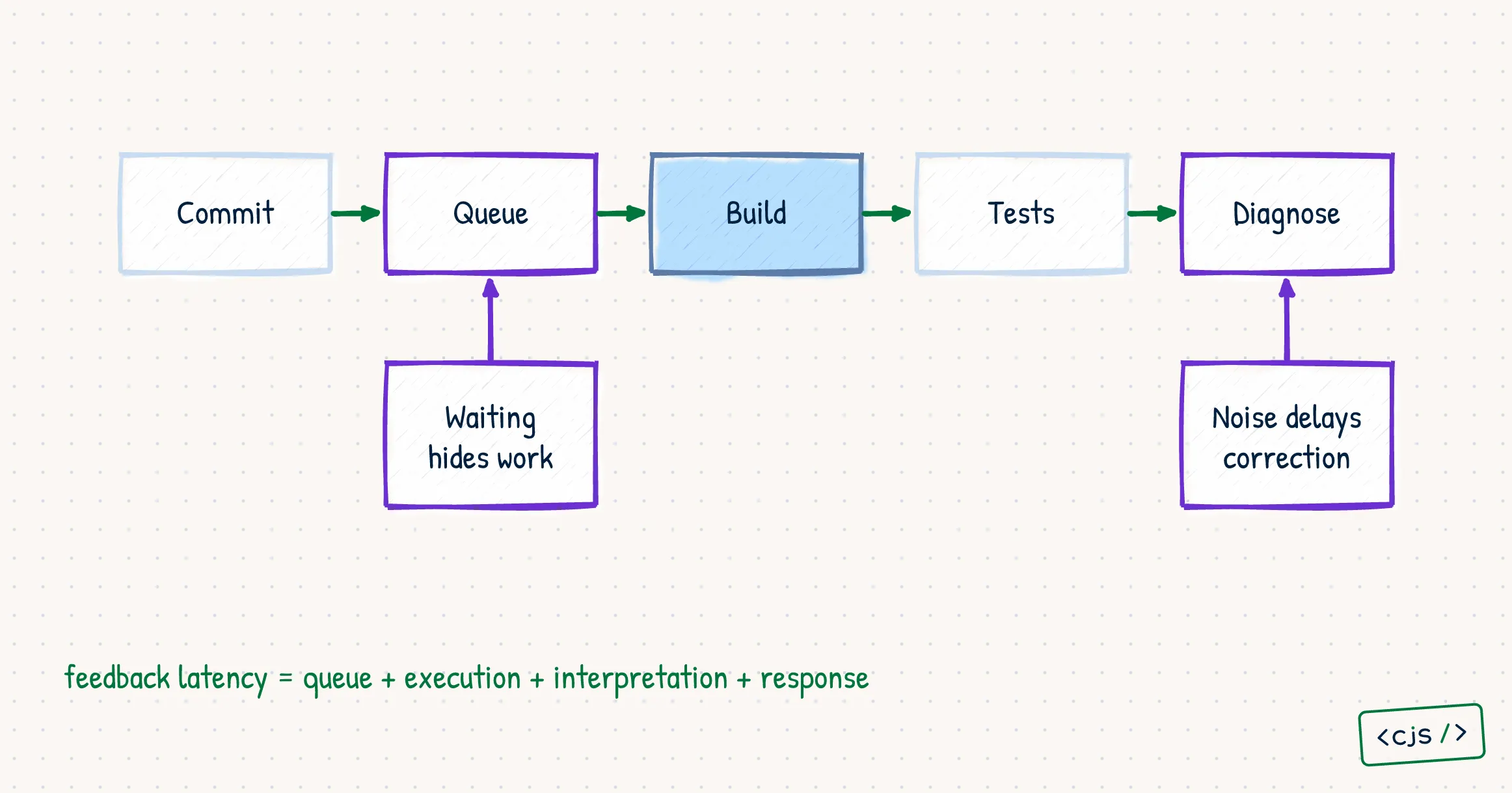
Treat feedback latency as a system budget:
- Queue time: how long a change waits for capacity.
- Execution time: how long setup, build, and checks run.
- Interpretation time: how long it takes to locate the meaningful evidence.
- Response time: how long before someone fixes or reverts the problem.
This framing changes optimization. More runners can reduce queues. Hermetic setup can remove environment drift. Test selection and parallelism can shorten execution. Better failure messages, focused logs, and retained artifacts can shorten diagnosis. Clear ownership can prevent a red mainline from waiting unattended.
DORA’s continuous integration capability guidance connects rapid feedback with small batches and makes restoring a broken build a priority. The feedback loop is organizational as well as technical.
A shared reference environment turns results into team knowledge
Local tests answer, “Does this work here?” CI adds a second question: “Does this change work in the environment the team has agreed to trust?”
That reference does not need to mirror every production detail. It does need to be reproducible and explicit. The source revision, toolchain, dependencies, configuration, test inputs, and commands should be reconstructable. Otherwise a green result is only a claim about an invisible machine.
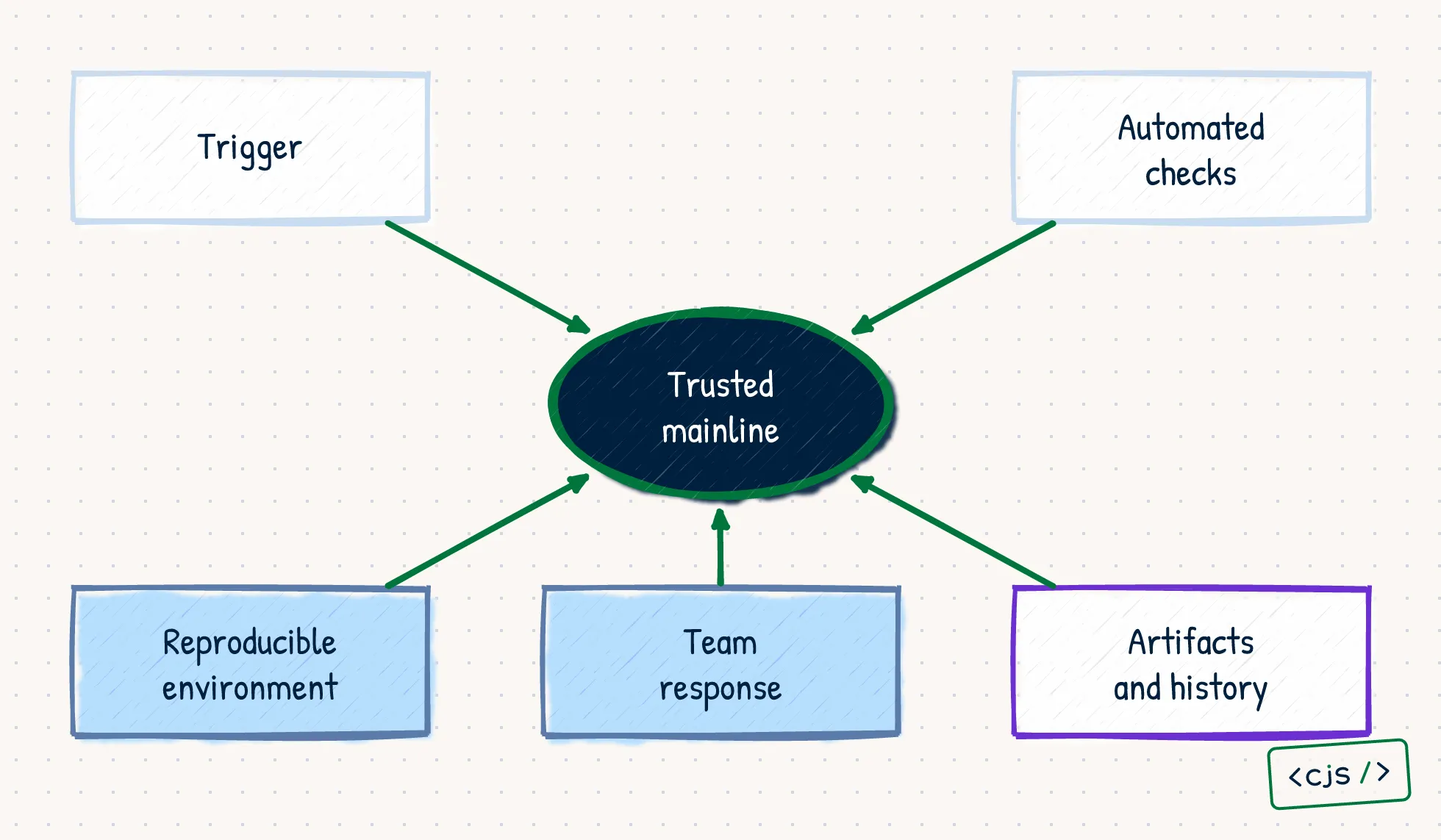
A useful CI system preserves more than pass or fail. It records which revision ran, which checks executed, what artifacts were produced, and where the failure occurred. That history lets the team compare runs, identify flaky behavior, and connect a regression to a narrow set of changes.
The mainline then becomes an observable system state. Developers can coordinate around it without asking whose laptop is correct. Release automation can consume it. Later, coding agents can inspect it. One shared environment converts individual activity into durable evidence.
DORA’s guidance on trunk-based development makes the relationship explicit: small, frequent integrations reduce the complexity of merge events and keep feedback close to the work that caused it.
Green is a protocol, not a color
A dashboard can display a red or green circle without changing how a team works. The signal matters only when everyone knows what it means and what happens next.
A trustworthy build is deterministic enough that people do not reflexively rerun it. It is fast enough that the author still remembers the change. It is specific enough to point toward a narrow cause. And it is owned: when mainline breaks, restoring it outranks starting unrelated work.
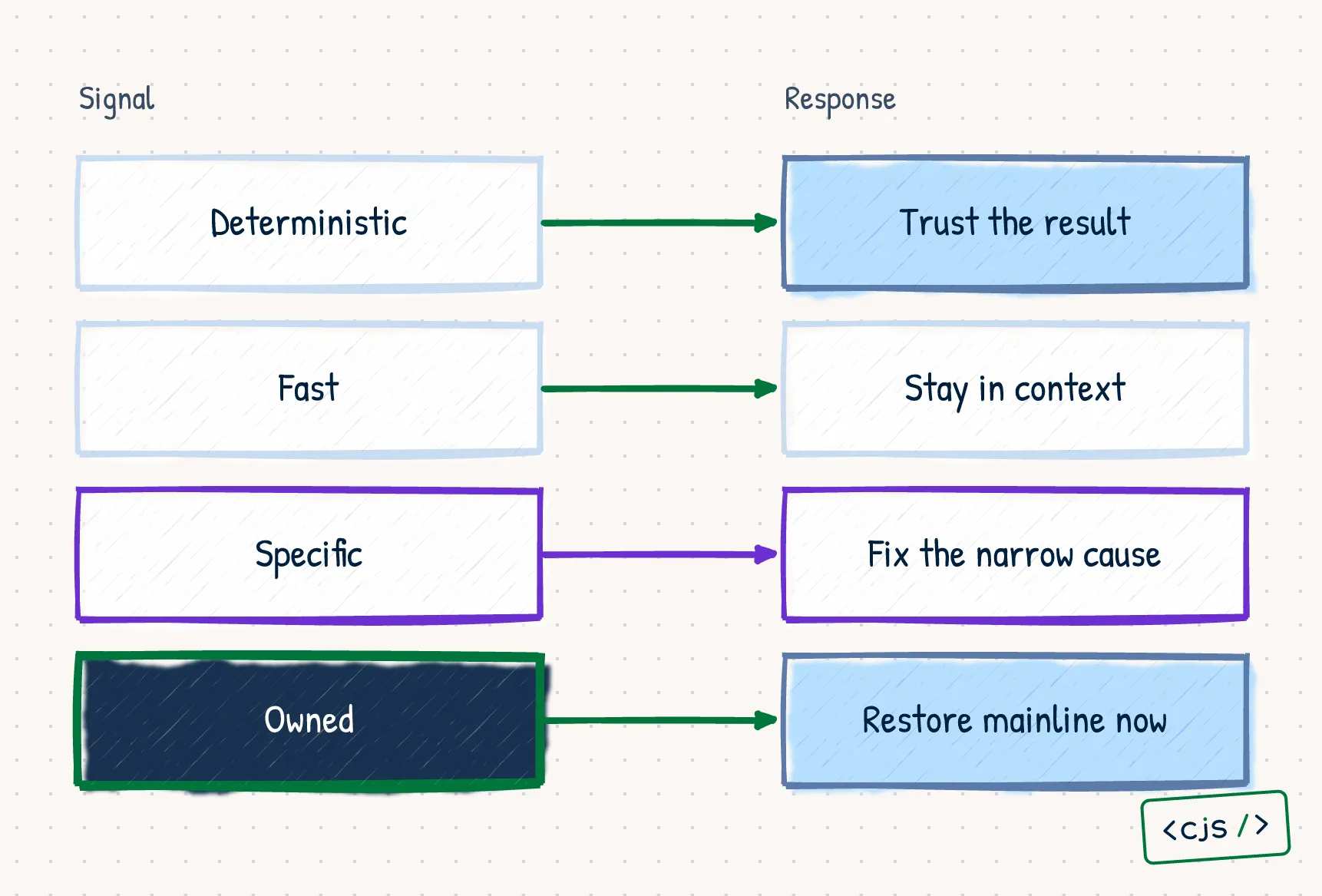
This is why CI cannot be installed as a tool and declared finished. The system includes batch size, branch lifetime, test design, compute capacity, artifact retention, notification routing, and team behavior. Any one of them can stretch the loop until feedback arrives too late to matter.
The practical review question is simple: after a change enters the system, how quickly can the right person see actionable evidence and make the next safe move?
The bridge to agent-first engineering
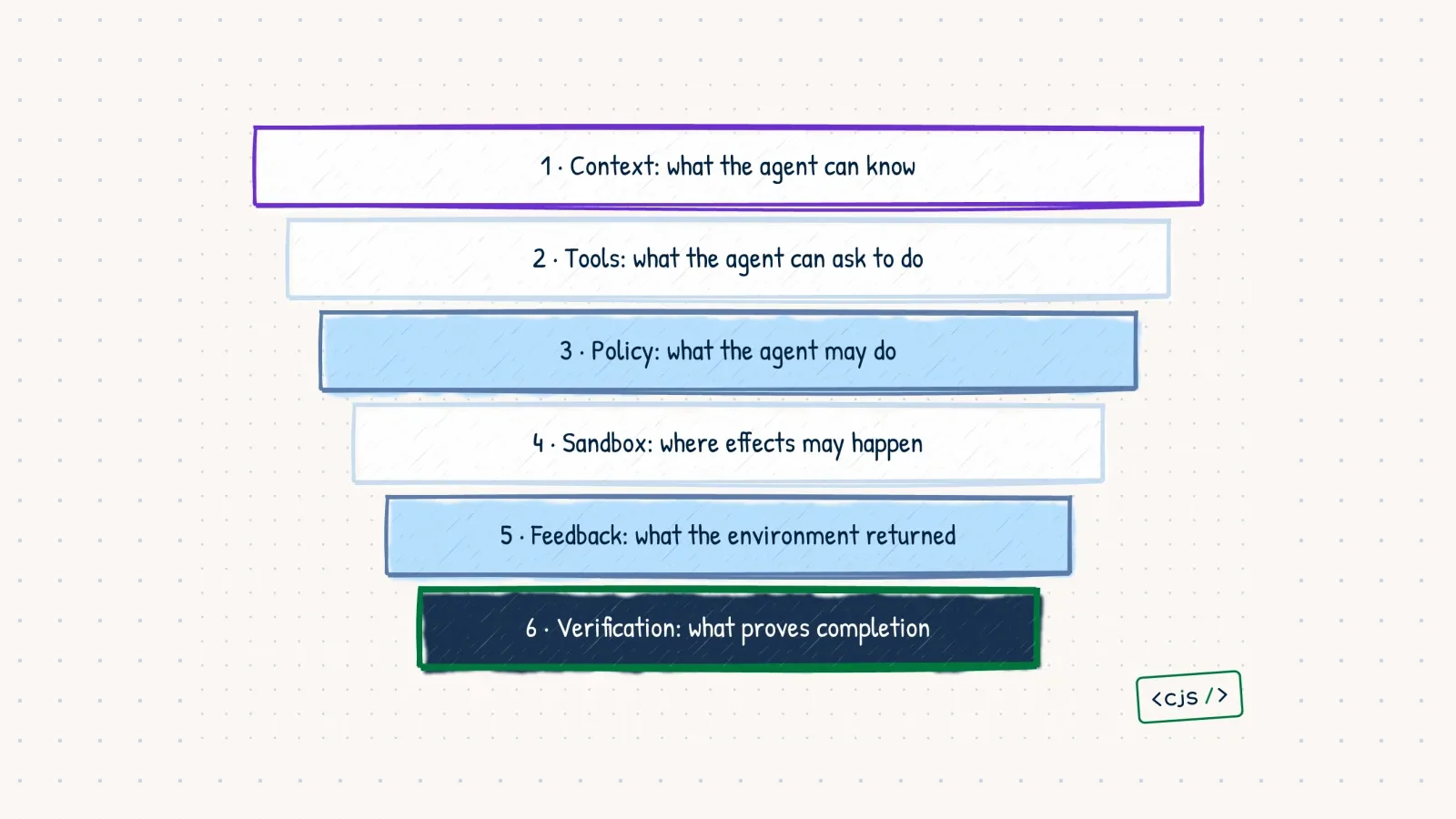
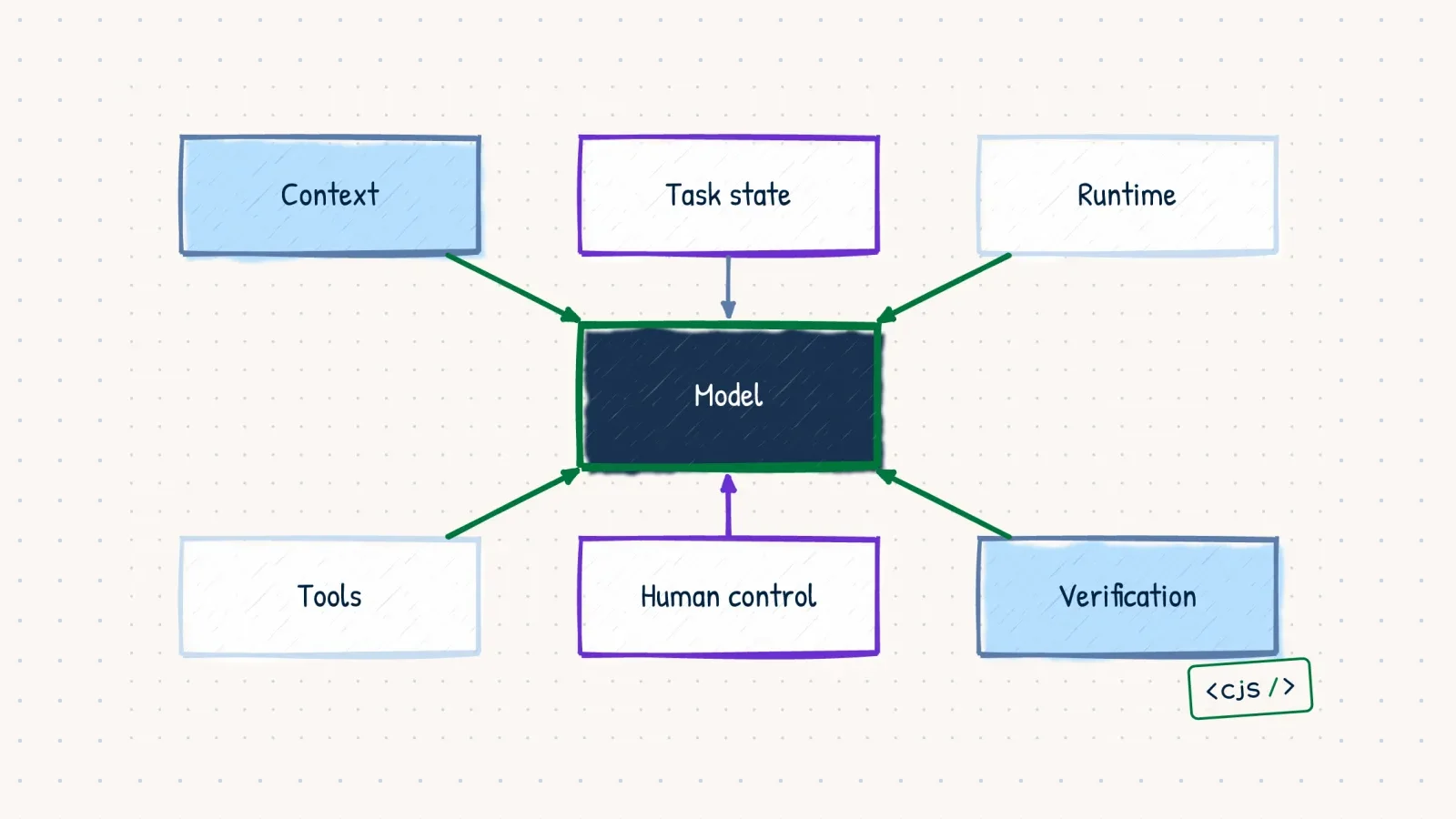
CI was one of software engineering’s first widely shared feedback harnesses. It standardized the environment, automated actions, preserved evidence, and made response rules visible across a team.
Coding agents inherit the same requirement at a tighter cadence. An agent that edits code but cannot trigger the reference checks, read a focused failure, inspect the resulting artifact, or know whether to stop is operating outside the team’s learning loop. Adding a model does not remove the need for CI; it raises the value of making CI legible to machines.
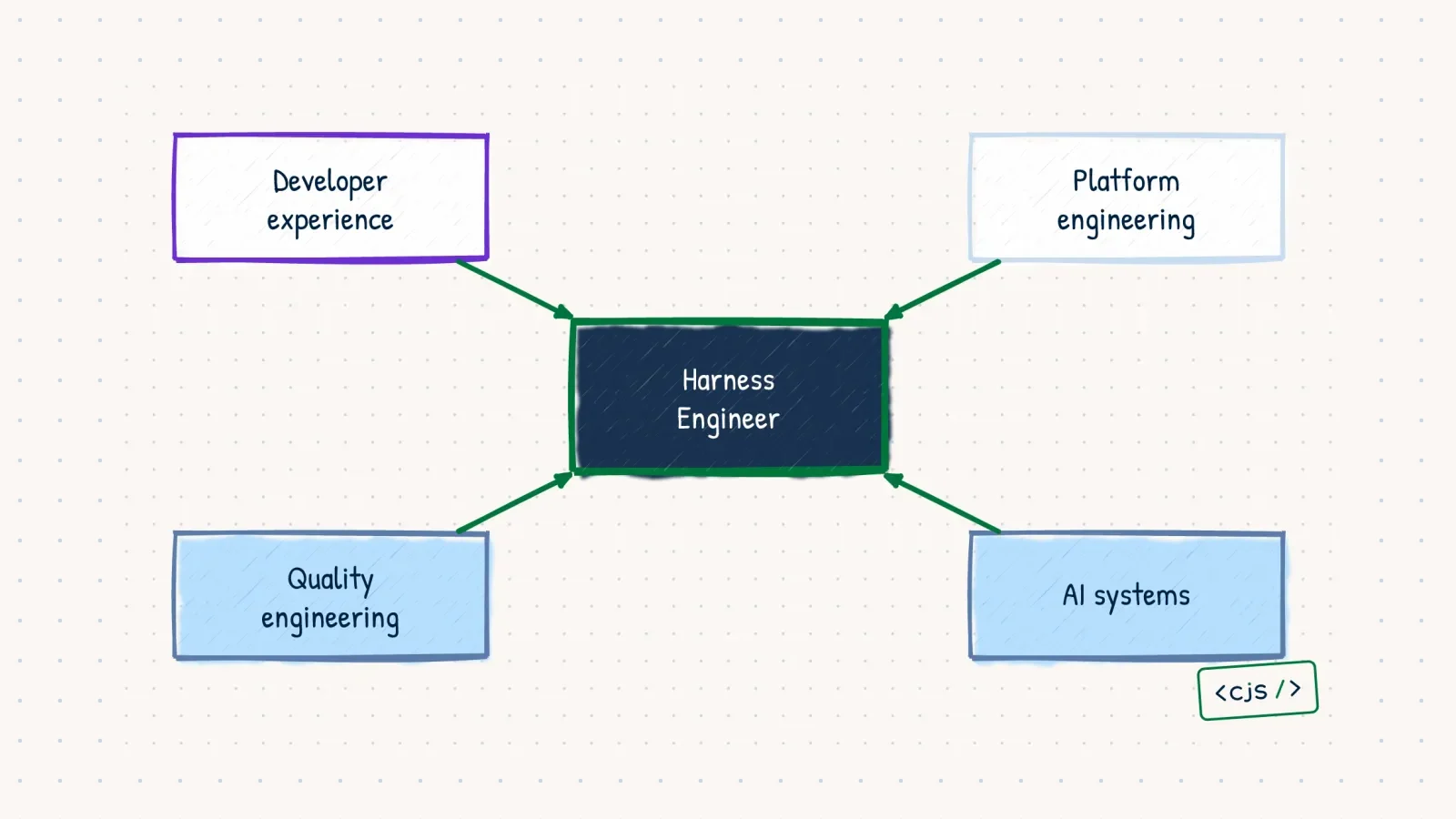
That is the larger arc of Harness Engineering: capability expands when feedback becomes infrastructure. The next step in the series is how AI pair programming expanded the task boundary from a local suggestion to a collaborative workflow.
Sources
- Martin Fowler and Matthew Foemmel — Continuous Integration, original version
- Martin Fowler — Continuous Integration
- DORA — Continuous integration
- DORA — Trunk-based development
- DORA — Working in small batches